


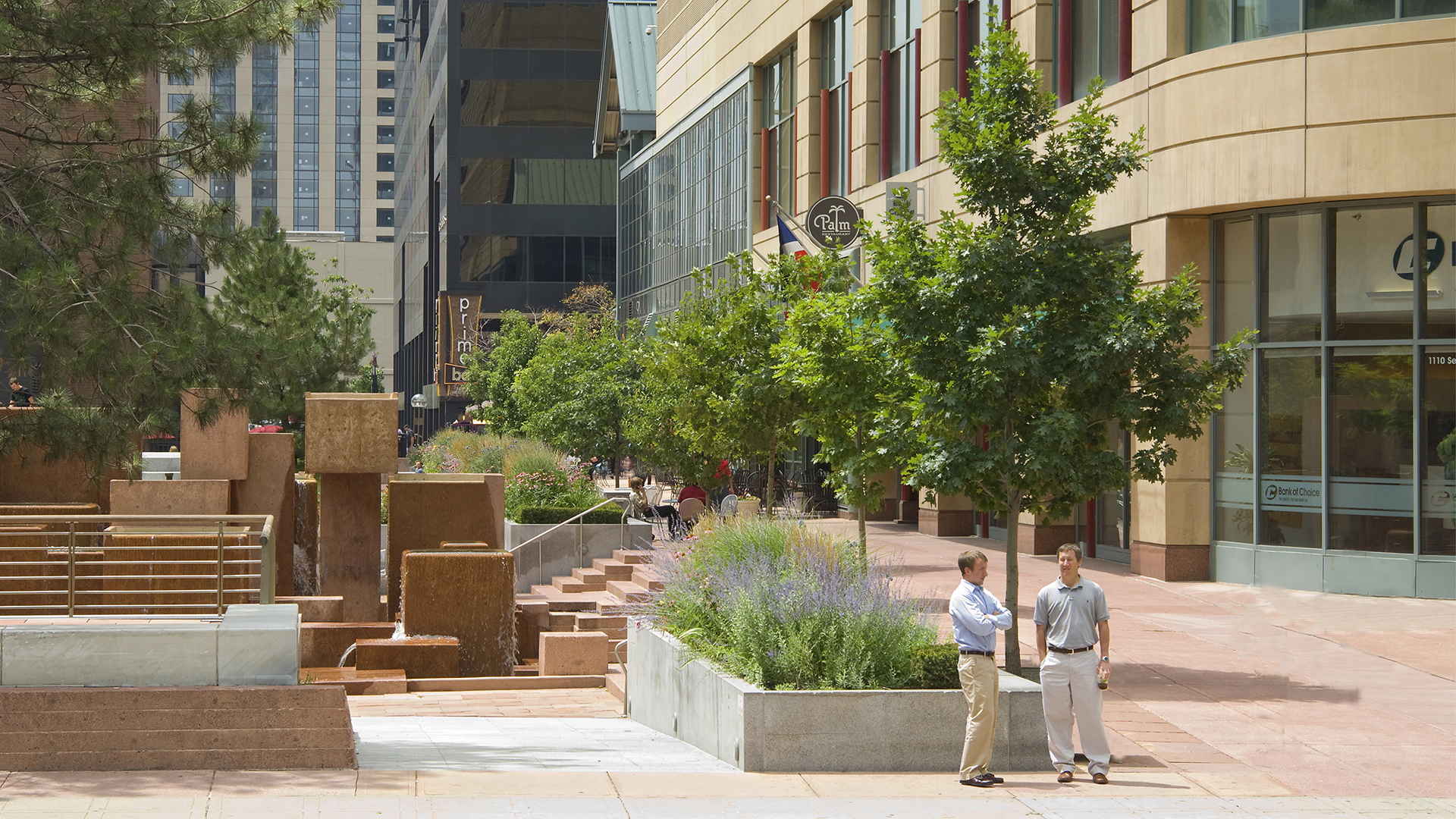


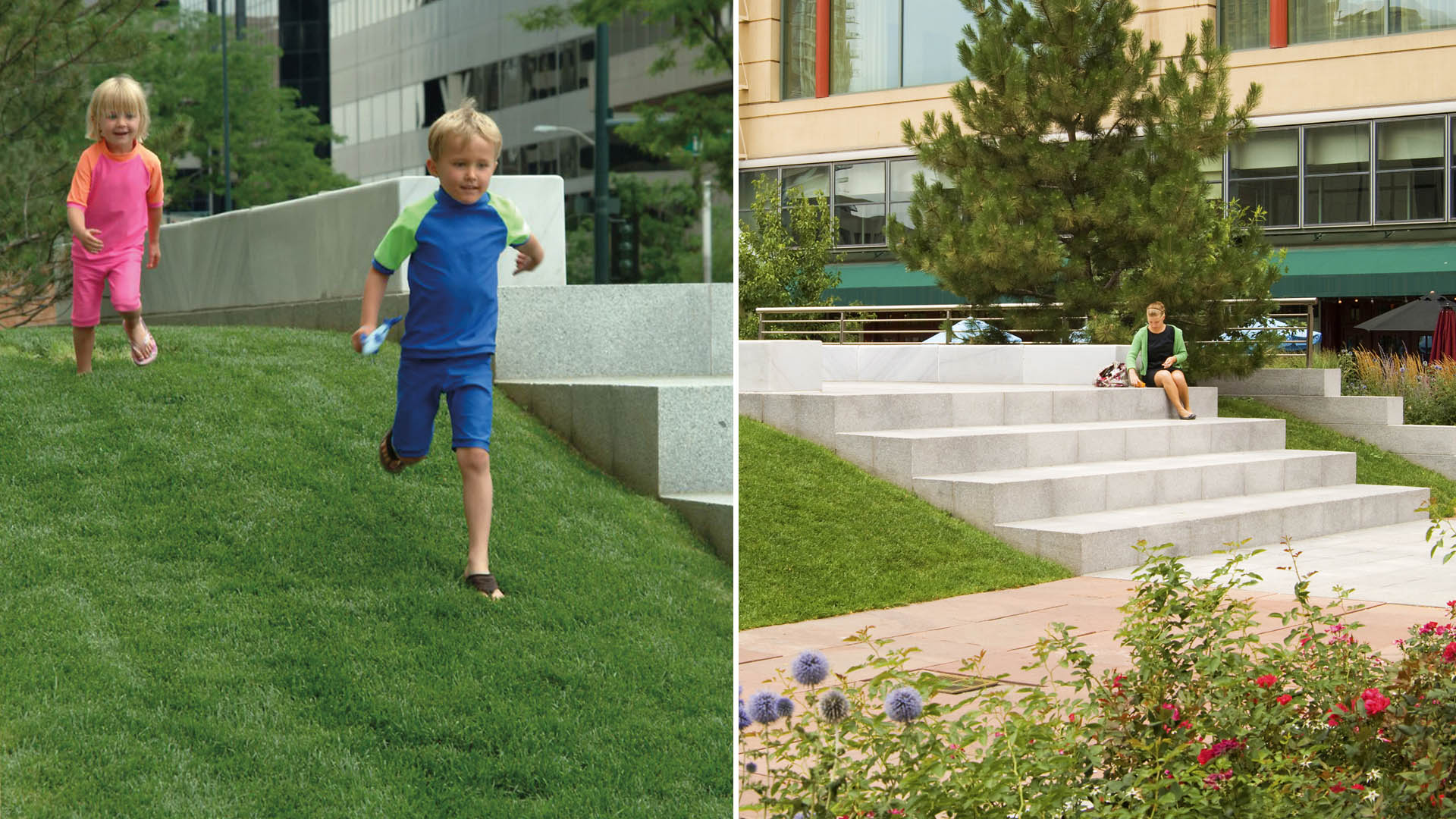


After an extensive public dialogue on its original design and performance, the City of Denver decided on a redesign of Skyline Park, downtown Denver’s only public open spaces. The three-block-long, three-acre, linear park is at the center of downtown Denver and is bisected by the 16th Street Mall, a lively pedestrian space that connects many of Denver’s attractions and transit hubs. Designed by Lawrence Halprin in the 1970s with sunken fountains, walls and berms, and without a sidewalk, the park was seen by many as a failed space, disconnected from nearby activities and streets, unsafe and plagued by a variety of social ills. The city’s goal was to carefully rethink the park’s program and profile in the re-emerging downtown and transform it into a vibrant civic venue for residents and workers as well as a locus of civic gatherings. An extensive public dialogue and outreach to Halprin ensued resulting in a direction for the park that would be based on memory and downtown’s future.
The linear park is conceived as a series of interwoven ribbons of new elements and materials. Existing Halprin elements, such as the fountains, have been sensitively retrofitted and combined with shade tree canopies and open lawns. Throughout the park are lawns—some flexible level areas that host a variety of celebrations and events; others lawn promontories from which daily urban life can be viewed. Café kiosks, shade pavilions, and interactive fountains contribute to the park’s extended activity. This system of intermingling layers—of elements old, new and adapted, at ground level and overhead—dramatically transforms these three blocks into a vibrant, successful and beloved park in the heart of downtown Denver.
Riverside Park South
On the West Side of Manhattan, on the scenic Hudson River shoreline, Riverside Park South is a massive, multi-phase project of sweeping ambition and historic scope. Combining new greenspace, new infrastructure, and the renovation of landmark industrial buildings, the plan—originally devised by Thomas Balsley Associates in 1991—is an extension of Frederick Law ...
Nelson Mandela Park Master Plan
Identified by the City as one of its “Big Five” open space projects, the conceptual master plan for Nelson Mandela Park will create a much-needed central open space for the city’s south district, an industrial area along the waterfront that is home to a growing and increasingly diverse population. Here the city seeks to transcend its current park paradigm of l...
Aitken Place Park
Aitken Place Park will be at the heart of Toronto’s East Bayfront Community – currently being transformed from an underutilized industrial brownfield into a vibrant waterfront neighborhood. Flanked by the residential development to the west and the commercial buildings to the north, the park’s water’s edge location presents a unique opportunity to create...
Soundview Park
Soundview Park, built on 212 acres of landfill at the junction of the Harlem and East Rivers in the South Bronx, is the most significant recreational facility in Community Board 9. As part of the PlanNYC initiative, Thomas Balsley Associates was selected as the lead designer of Soundview’s master plan. This brownfield remediation will drastically improve both ...